"How much does one bar cost me?" sounds like a simple question. Then you remember the recipe is in percentages, oils come in different pack sizes, the lye calculator gives you grams, and the batch shrinks while it cures. This guide shows how to get from a recipe to a reliable cost per bar, then to a price. We'll use a real 1 kg (oil weight) cold process recipe as the example.
Safety note: this article is about costing. It is not a lye calculator. Always run your recipe through a dedicated lye calculator, weigh lye precisely and follow safe handling practices.
The short version
Cost per bar = (batch ingredient cost ÷ bars per batch) + packaging per bar + labor per bar + overhead per bar
The trick is to cost the whole batch first, then divide. Trying to cost a single bar directly is where most errors come from.
Step 1: Price every oil per kilogram (or pound), including shipping
Write down what you actually paid, shipping included, and convert to one unit. We'll use cost per kg:
| Oil / butter | % of oils | Cost per kg (incl. shipping) |
|---|---|---|
| Olive oil (pomace or refined) | 45% | $6.50 |
| Coconut oil 76° | 25% | $5.00 |
| Shea butter | 15% | $9.00 |
| Cocoa butter | 10% | $14.00 |
| Castor oil | 5% | $8.00 |
If a supplier sells by the pound, divide the price by 0.4536 to get the price per kg (or multiply by 2.2046). If you use pounds and ounces throughout, that's fine, just don't mix units.
Step 2: Turn the recipe percentages into a batch cost
For a batch with 1,000 g of oils, each oil's weight is simply its percentage × 1,000 g. Its cost is that weight in kg × cost per kg:
- Olive: 450 g → 0.45 × $6.50 = $2.93
- Coconut: 250 g → 0.25 × $5.00 = $1.25
- Shea: 150 g → 0.15 × $9.00 = $1.35
- Cocoa butter: 100 g → 0.10 × $14.00 = $1.40
- Castor: 50 g → 0.05 × $8.00 = $0.40
Oils: $7.33 (exact $7.325)
Notice cocoa butter: only 10% of the recipe, but it costs more than the coconut oil at 25%. Expensive butters are where a recipe change saves the most.
Step 3: Add lye, water, fragrance and color
Your lye calculator gives the sodium hydroxide amount. For this recipe at 5% superfat it's about 139 g NaOH (always check with your own calculator, as SAP values vary by source).
- NaOH: 139 g at $10/kg = $1.39
- Distilled water: about 330 g = roughly $0.10
- Fragrance oil: 3% of oil weight = 30 g. At $28 + $4 shipping for a 16 oz (454 g) bottle that's $0.0705/g → $2.11
- Colorant (mica/clay): $0.30
Batch ingredient cost: $7.33 + $1.39 + $0.10 + $2.11 + $0.30 = $11.23
Fragrance is the second-biggest line after the oils. At a 5% usage rate instead of 3%, it would cost $3.52, more than all the lye and color together. Essential oils can be several times more expensive than fragrance oils, so cost them carefully.
Step 4: Divide by the number of bars you actually sell
This 1 kg batch fills a loaf mould that we cut into 10 bars. Use the count of sellable bars: if you trim the ends or lose one to a crack, divide by 9, not 10.
Ingredients per bar: $11.23 ÷ 10 = $1.12
What about water loss during cure? Bars get lighter as water evaporates, but the cost per bar doesn't change: you paid for the same ingredients and you still have 10 bars. Water loss matters for the weight you print on the label, not for the cost. (If you sell by weight, label the cured weight and check your local labelling rules.)
Step 5: Packaging per bar
A paper band with your label and a bit of shrink wrap or a box:
- Label/band $0.25 + wrap $0.05 = $0.30 per bar
Boxes, ribbon and stickers add up fast. A $0.90 gift box can cost almost as much as the soap inside.
Step 6: Labor, the line most soap makers leave out
Count everything: weighing, mixing, pouring, cleaning up, cutting, beveling, curing checks, wrapping and labelling. Our 10-bar batch takes about 2.5 hours from start to wrapped bars. At $18/hour that's $45 for the batch:
Labor per bar: $45 ÷ 10 = $4.50
That's four times the ingredient cost. This is normal for small batches, and it's the reason batch size is the biggest lever on your cost per bar.
Step 7: Overhead per bar
Monthly costs like moulds and equipment wear, testing batches, insurance, market fees and software: say $50 a month over 100 bars sold.
Overhead per bar: $0.50
The total, and what batch size does to it
| Per bar | 10-bar batch (2.5 h) | 20-bar batch (3 h) |
|---|---|---|
| Ingredients | $1.12 | $1.12 |
| Packaging | $0.30 | $0.30 |
| Labor at $18/h | $4.50 | $2.70 |
| Overhead | $0.50 | $0.50 |
| Total cost per bar | $6.42 | $4.62 |
Doubling the batch adds only half an hour of work, so labor per bar drops from $4.50 to $2.70. Same recipe, $1.80 cheaper per bar. If your mould and curing space allow it, bigger batches are the easiest margin you'll ever find.
From cost per bar to price
Handmade bars of this size commonly sell for roughly $8–12 at markets and online in the US and UK. Let's test three prices against the 20-bar cost of $4.62.
At a craft market with a card reader (about 2.6% + $0.15 per payment in the US, varies by provider and country):
- $9 bar: fee $0.38 → profit $3.99
- $10 bar: fee $0.41 → profit $4.97
- $12 bar: fee $0.46 → profit $6.92
On Etsy (roughly 9.5% + $0.45 per order including listing, transaction and payment fees, more if a sale comes through Offsite Ads):
- $12 bar: fee $1.59 → profit $5.79
And remember, these profits come after paying yourself $18 an hour. With the 10-bar batch, the $9 bar would only leave $2.19, which is why many soap makers feel busy but broke.
Two more pricing tips:
- Sell sets. A three-bar gift box at $30 shares one box, one label and one fee, so it's often your most profitable item.
- Price wholesale from the cost, not from retail. At 50% of a $10 retail price, a wholesale bar earns $5.00 − $4.62 = $0.38. That's barely worth it. If you want stockists, aim for $12 retail or cut your cost per bar.
Common soap costing mistakes
- Ignoring shipping on oils. Heavy liquids are expensive to ship, so put it into the cost per kg.
- Costing by the recipe percentages without a batch size. Percentages tell you the ratio, not the cost. Always calculate a concrete batch.
- Dividing by bars poured instead of bars sold. End pieces and seconds are usually given away or used for testing.
- Forgetting that fragrance varies by scent. A premium fragrance oil can double the fragrance line. Cost each scent separately if prices differ.
- No labor. If you can't afford to pay yourself, the price is wrong or the batch is too small.
Do it once, reuse it forever
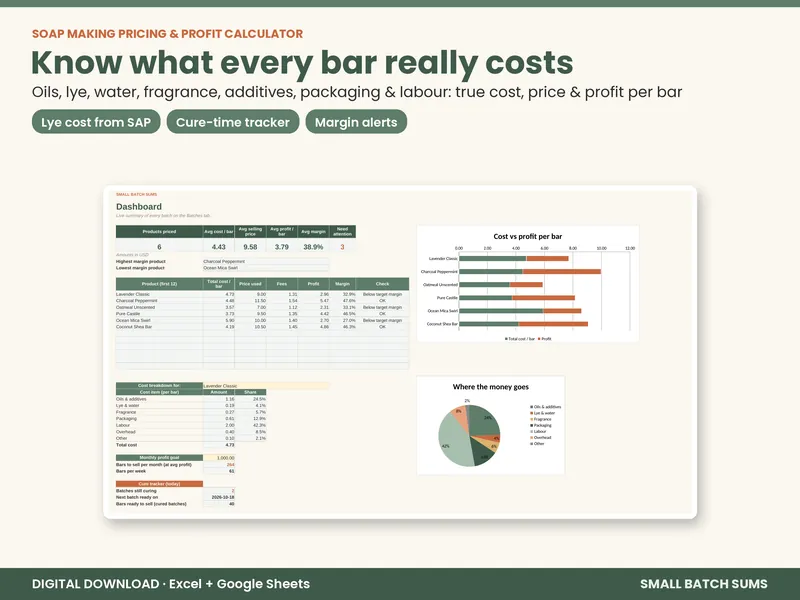
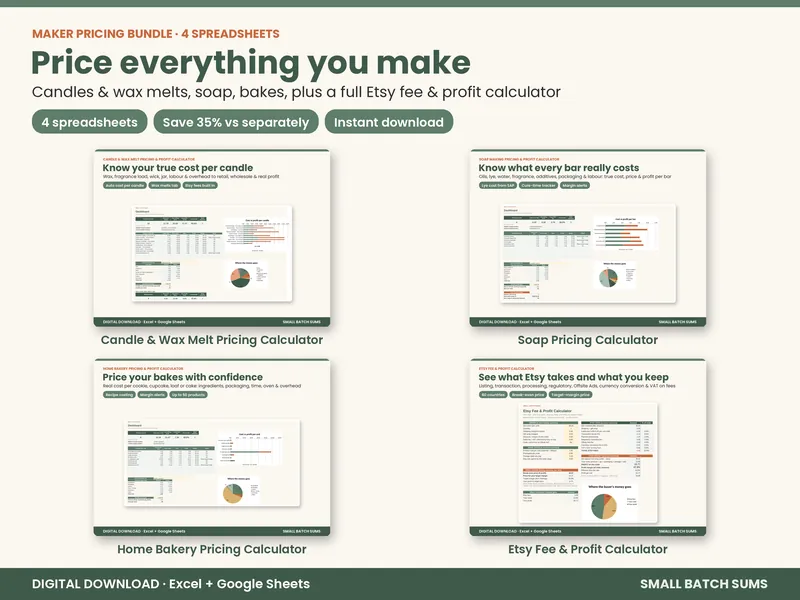
Our Soap Pricing Calculator lets you enter oil prices once, build recipes in percentages for any batch size, and get the cost per bar, suggested retail and wholesale prices, and profit after fees for every recipe side by side. It's also part of the Maker Pricing Bundle.